Hide this

Results from Google Books

Click on a thumbnail to go to Google Books.

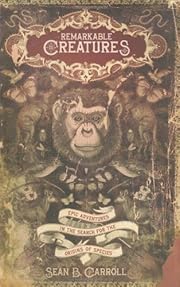
Remarkable Creatures: Epic Adventures in the Search for the Origin of Species by Dr. Sean B. Carroll
Loading...

Remarkable Creatures: Epic Adventures in the Search for the Origin of…

by Dr. Sean B. Carroll

MembersReviewsPopularityAverage ratingConversations
80679,085 (4.12)6
Loading...
won't like will probably not like will probably like will like will love

Sign up for LibraryThing to find out whether you'll like this book.

Showing 1-5 of 6 (next | show all)
This is a very entertaining and informative look at the lives, careers and discoveries of scientists who have contributed to our understanding of evolution in the last 200 years, beginning with Alexander von Humboldt's travels in South and Central America, through Darwin, and then to a host of others who have expanded on a science which in 150 years has changed our understanding of the places Earth and humanity have in the universe.

The book's not perfect. The treatment is uneven, with some chapters having much more detailed science while others read like a boy's life of a famous person (I'm dating myself there). The old photos are reproduced on regular paper, so some are difficult to make out. There are no numbered footnotes, but there are extensive chapter bibliographies at the end of the book as well as a detailed index. All-in-all, this is a wonderful introduction for the general reader.

One thing I particularly liked is that by the end the reader has a real feeling for what an uphill battle the early explorers had, in figuring out where to start geographically, where to get funds, and what to look for, and then in surviving in the field in primitive and dangerous conditions without a certain support system and with infrequent communication with the outside world. They often spent years at this, not knowing if there would be any success or acceptance of what they discovered and how they thought it fit into the scheme of science.

The other impression I came away with is the enormous gap in knowledge which has been filled in in just 150 years. This is no longer solely about fieldwork discoveries. Some of the most sophisticated sciences, such as DNA sequencing, are not only substantiating the original theory but taking it in wholly unexpected directions. It was a bit shocking to see laid out so clearly just how far beyond the simple question of evolution we've gone. That train has left the station. The science being done now is not concerned with whether evolution is real but in exploring in ever more deeply what that means for our place in life, and for the possibility of finding life elsewhere. And, of course, there's always the question of what's next for our own race in its evolution. ( )
  auntmarge64 | Jan 20, 2010 |
My knowledge of Paleontology begins with a grade school trip to The Museum of Natural History and ends with seeing Jurassic Park eight or nine times. I don’t think I’m alone. Remarkable Creatures: Epic Adventures in the Search for the Origins of Species by Sean B. Carroll seeks to remedy this gap in public knowledge. The book is an overview of the history of Evolution, starting with Darwin (where else?) and ending in Space. It is well written, informative and mostly interesting. However, it does get off to a slow start.

Remarkable Creatures is divided into three parts. Part One, unfortunately, comes across as targeting young adults – which I don’t think was the author’s intent. Sometimes, even in science, life is about being in the right place at the right time. That becomes all too apparent in the book’s early chapters. Fossils and skulls seem to have been so thick on the ground in the beginning days of paleontology that a would-be naturalist only had to take three steps into the Gobi Desert to trip over a major find. Of course it wasn’t that simple (is it ever?), but Dr. Carroll’s writing in these early chapters has a sing-song, disingenuous quality to it that can be a tad too enthusiastic. Much of what these early naturalists did, though extraordinary, frankly isn’t all that complicated to explain… They researched what they were looking for, found the most suitable geological conditions on a map, and off they went. Nothing easier. Anyone can do it. Why am I reading this when I can be watching an Indiana Jones Marathon??? (Parts 1-3. We at BookSexy like to pretend that the Kingdom of the Crystal Skull NEVER happened).

Well, enjoy your false sense of superiority while you can. Approximately halfway through Part Two, in Chapter 8: The Day the Mesozoic Died to be exact, it’s over. Along with the more recent discoveries in paleontology you will learn a little lesson on humility. Dr. Carroll introduces the K-T Boundary: proof that a giant comet probably did kill the dinosaurs and **SPOILER ALERT** impacted off the Yucatan Peninsula. (Uh…yeah… anyone else think that was made up by Hollywood?) Suddenly you’ll be learning about things with names like Foraminifera, Isotopes, Tektites and that the half life of beryllium-10 deposits in clay is too short to be usefully measured after 65 million years. And that’s still just in Chapter 8! Later chapters go on to discuss the relationship between dinosaurs and birds, the discovery of the “fishapod“, and the use of DNA in tracing human origins. (I’m not ashamed to admit to wiping away tears of gratitude as I read the three page explanation of how DNA is decoded that the good Doctor so thoughtfully inserted into Chapter 12). The book ends with a too brief discussion on the continuing search for life in space and how its existence, or non-existence, will impact our own. The search for the origins of species is a science that is far from being exhausted.

Sean B. Carroll is one of those intelligent human beings who offers the rest of us the chance to become smarter. Because of that, Remarkable Creatures: Epic Adventures in the Search for the Origins of Species is a great book. Dr. Carroll builds the story slowly and carefully, each section creating a foundation of knowledge that allows us to understand the section which follows. At its end, you still won’t be an expert. But you will walk away much smarter than when you started, with a deeper understanding of things most people know of without really knowing anything about. And while this may have limited applications socially – (“Hi! My name is _____! Did you know that mitochondrial DNA can in theory be traced back to a single maternal ancestor – a hypothetical Eve?” may not be the strangest pick-up line I’ve ever heard, I still wouldn’t really recommend it.) – when the topic of conversation does eventually come up you will definitely be ahead of the curve. Unless, of course, you’re meeting someone at the Museum of Natural History. Which really isn’t a bad idea at all. ( )
  tolmsted | Dec 24, 2009 |
All truths are easy to understand once they are discovered; the point is to discover them.

This book is a chronicle of the greatest adventures in natural history in the last 200 years. The author Sean Carroll, a professor of genetics at the University of Wisconsin-Madison, looks at the lives of people who had gone into the wild, with one purpose, to find evidence of evolution. He starts with Darwin and his voyage around the world. Darwin's passion for collecting and for exploring the unknown was remarkable, and helped him endure the loneliness, constant seasickness, discomfort, and dangers of the voyage.

Next is Alfred Russell Wallace with his two expeditions. Wallace spent in the Amazon four years and he almost lost his life when the ship that was bringing him in England caught fire and sank along with almost all the specimens he had collected. He was rescued, after ten days in a lifeboat, only to leave again, this time to New Guinea, where he spent eight years collecting. It was there, that he came up with the same idea Darwin did, about the evolution, of species.

One of most interesting portraits in the book is the one of Charles Walcott. Despite the fact that he never finished formal education, he developed a passion for fossils and became an expert on trilobites - they are arthropods that went extinct in the Permian. He was the first to explore and survey the rocks and the fossils in the Grand Canyon only with himself, a cook and a mule. The task was enormous, but it didn't deter Walcott to make one of the major discoveries in the field of natural sciences. He found the earliest fossil evidence of life; the simplest form of life, during the Precambrian period. Later, Walcott become director of the U.S. Geological Survey, and a trusted advisor to seven different presidents. He also played and significant role in promoting aviation in the United States, and helped in the creation of a new organisation called NACA which was the civil aviation authority in the US and 50 years later, developed into being NASA.

Carroll also talks about Eugene Dubois, who found in Java the missing link between apes and humans. It was a molar skullcap and a thigh bone of what we called today, Homo Erectus. Probably the most exciting portrait is that of Roy Chapman Andrews. He had an intriguing personality; an explorer and adventurer, a spy and gifted scientist. He was captivated by Mongolia and the Gobi desert. With his team he discovered the first nest of dinosaur eggs and several new dinosaur species, including Velocipartor and Tarborsaurus.

The book is beautifully written. The description of the adventures and struggles of the scientists to discover and fill the gaps in the natural history and human evolution is captivating, and easily grasps the attention of the reader, especially the younger ones. The photographs, maps and charts are useful supplement in the text. The reading list is extensive and comprehensive, and definitely you should go through it. In total, the book is highly recommended. ( )
  AthenaStefania | Aug 31, 2009 |
Darwinmania! Evolution is hot, hot, hot! So everyone is writing about the man, his ideas or his science. Sean Carroll’s book reads like any other cash-in book. It is not really about Darwin and it is not really a history or study of Darwinism.

This book is a collection of stories about various adventurers who have in some way advanced our knowledge of evolution. Each is written like a Sunday supplement article for easy reading over brunch. Not enough science and not enough history for my taste.

This would, I suppose, be a good book for an early teenager to get a taste of what adventure is really like in the world. ( )
  pierthinker | Jul 26, 2009 |
In Remarkable Creatures Sean Carroll takes you on a ride through the history of biology and the development of the theory of evolution. He uses the stories of many fascinating and intrepid explorers to guide us all the way from the discovery of many new species all the way through paleontology to DNA mapping. The book includes a lot of heavy-duty science with very complete descriptions of how the theory of evolution developed and the fossil records that helped support it. Interspersed are the stories of the many explorers and scientists who often risked everything to find the answers to some of the most compelling questions in biological studies. Carroll shares with us their triumphs, but also their romances, family lives, and struggles, showing us the whole picture.

I really enjoyed this book! I learned a lot about biology and especially about paleontology. I loved hearing about the wives and families that often played key roles in discovering important fossils. ( )
1 vote frisbeesage | Mar 22, 2009 |
Showing 1-5 of 6 (next | show all)
no reviews | add a review
You must log in to edit Common Knowledge data.
For more help see the Common Knowledge help page.
Series (with order)
Canonical Title
Original publication date
People/Characters
Important places
Important events
Related movies
Awards and honors
Epigraph
Dedication
First words
Quotations
Last words
Disambiguation notice
Publisher's editors
Blurbers

References to this work on external resources.

Wikipedia in English

None

Book description

Amazon.com Product Description (ISBN 015101485X, Hardcover)

An award-winning biologist takes us on the dramatic expeditions that unearthed the history of life on our planet.

Just 150 years ago, most of our world was an unexplored wilderness. Our sense of how old it was? Vague and vastly off the mark. And our sense of our own species’ history? A set of fantastic myths and fairy tales. Fossils had been known for millennia, but they were seen as the bones of dragons and other imagined creatures.

In the tradition of The Microbe Hunters and Gods, Graves, and Scholars, Sean Carroll’s Remarkable Creatures celebrates the pioneers who replaced our fancies with the even more amazing true story of how our world evolved.

Carroll recounts the most important discoveries in two centuries of national history — from Darwin’s trip around the world to CharlesWalcott’s discovery of pre-Cambrian life in the Grand Canyon; from Louis and Mary Leakey’s investigation of our deepest past in East Africa to the trailblazers in modern laboratories who have located a time clock in our DNA. Join him in a rousing voyage of discovery, from the epic journeys of pioneering naturalists to the breakthroughs making headlines today.

(retrieved from Amazon Tue, 05 Jan 2010 17:15:34 -0500)

(see all 2 descriptions)

The first test round has been closed. Visit the Open Shelves Classification group for details.

Quick Links

Ebooks Audio Swap
2 pay0/24

Popular covers


Help/FAQs | About | Privacy/Terms | Blog | Contact | LibraryThing.com | APIs | WikiThing | Common Knowledge | 48,411,097 books!
